Toast - Local Restaurants
- 4.8
- Rating
- 1.00M
- Installs
- Free
- Price

 Analysis by App-foxy
I started using Toast - Local Restaurants because the idea is simple: choose a nearby restaurant, place an order before arriving, and spend less time waiting around. That sounds like a small convenience, but it matters most during rushed lunches, school pickups, busy evenings, and those moments when I am already hungry enough to make poor decisions. After using it as a Food & Drink app rather than treating it like a one-time novelty, I found that its value depends heavily on where I live and which restaurants I visit regularly.
The app is free, aimed at Everyone, and developed by Toast, Inc. Its public presence is substantial, with more than a million installs and a 4.7 average from roughly twenty-seven thousand ratings. Those numbers suggest that the basic ordering idea works for a large audience, but they do not answer the more useful question: will it remain worth keeping on your phone after the first few orders? My answer is mostly yes, provided your favorite local restaurants use Toast and you are comfortable checking the order details carefully before paying.
What using Toast feels like beyond the first order
I look beyond the first successful pickup to judge whether Toast fits into a routine without demanding extra attention. In this section, I consider how its ordering flow holds up when I’m tired, short on time, or relying on a familiar meal, and why a quick final check can make the difference between a helpful shortcut and an avoidable mix-up.
You May Also Like

 Blood Strike: 2.5 Anniversary
Blood Strike’s Loadouts Turn Every Drop Into a Tactical Gamble
A close look at Blood Strike’s custom loadouts: how fast access to signature weapons reshapes its battle royale rhythm, rewards preparation, and narrows the gap between fights.

 Pandora - Music & Podcasts
Pandora’s Music Is Easy to Start, but Harder to Recover
Pandora’s strength is its low-effort path from a seed to a station. Its weak spot is how much confidence it asks you to place in connection, setup, and quiet recovery.

 8 Ball Pool
 Is Built on Rivalries, Rematches, and Routine
A close look at the rivalries, rematches, shared routines, and unanswered safety questions that turn a quick pool match into a persistent mobile community.

 Samsung Music
’s Quiet Strength Is Playing What You Already Own
Its reach comes less from spectacle than from dependable access to a personal library. That simplicity is both the app’s strongest retention engine and its ceiling.

 AccuWeather: Weather Radar
AccuWeather Review: A Quick, Clear Forecast for Everyday Decisions
For everyday plans, the best forecast is the one you can understand quickly. AccuWeather makes rain timing, radar, and local conditions easy to act on, with a few trade-offs.

 Hill Climb Racing
Why Hill Climb Racing Still Turns Crashes Into One More Run
A tiny car, a bumpy hill and one more upgrade: Hill Climb Racing keeps resurfacing because its simple chaos makes every near-miss feel personal.
More From Our News Desk



The first-week appeal comes from removing small delays
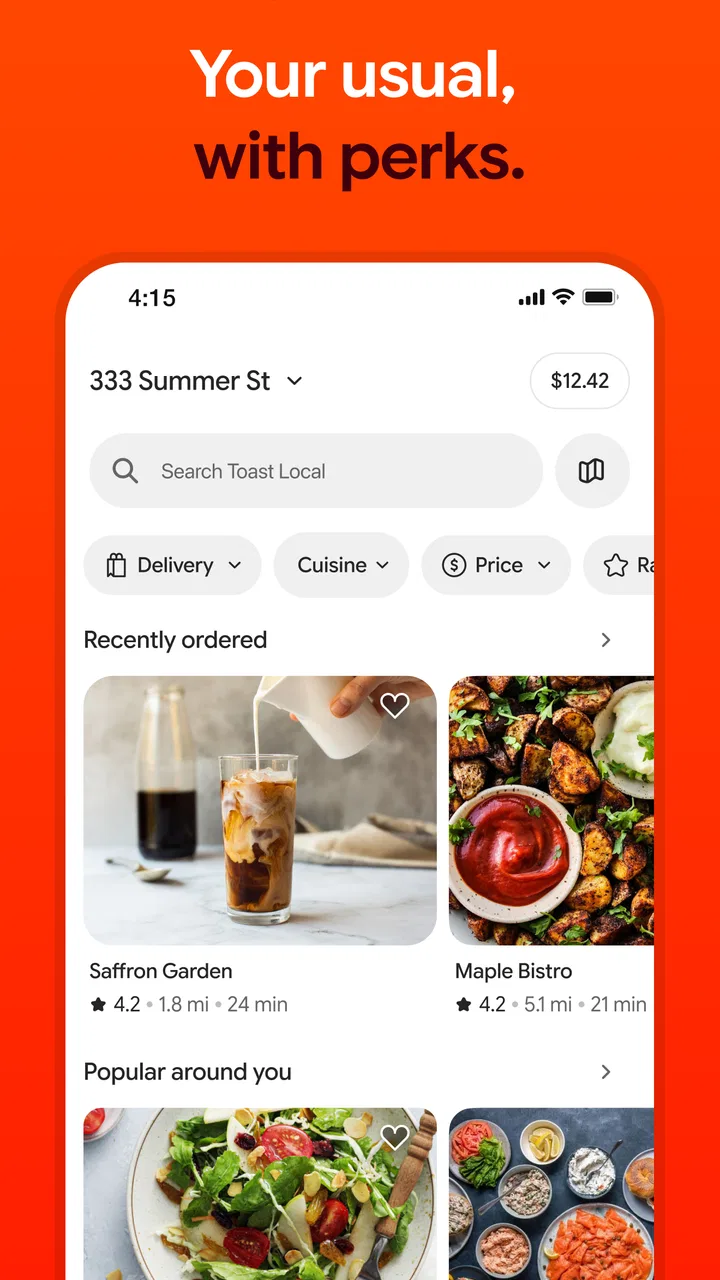
The strongest part of the experience is not discovering a complicated feature set. It is the reduction of friction between deciding what to eat and actually receiving it. Instead of joining a queue at the counter, I can look through a participating restaurant’s menu, customize the order, and arrange it ahead of time. That workflow is especially useful when I know exactly what I want and do not need a long browsing session.
A realistic example is a weekday lunch when I have only a short break. I can open Toast while finishing another task, select a familiar restaurant, adjust the meal, and place the order before leaving. If the restaurant has the food ready when I arrive, the app has saved more than a few taps; it has made the whole stop predictable. That predictability is the reason I would recommend trying it before judging it as just another restaurant-ordering app.
The first week also reveals an important limitation: Toast is not automatically a universal directory of every place nearby. Its usefulness follows the restaurants that use Toast. If your preferred café, takeaway counter, or neighborhood restaurant is not available through the service, the app cannot solve that gap. I found it better to think of Toast as a direct ordering door for supported restaurants, not as a complete map of local food.
Menu browsing is most comfortable when I already have a destination in mind. I can review choices and make decisions away from a crowded counter, which is helpful for complicated orders or when I want to check ingredients and options at my own pace. It is less compelling when I am simply asking, “What should I eat?” For broad restaurant discovery, a map app or a dedicated delivery marketplace may offer a wider starting point.
One useful habit is to read the entire order summary before submitting it, even when I am ordering a familiar meal. Customizations, quantities, pickup timing, and restaurant-specific choices can change the result. The app makes ordering convenient, but convenience can encourage fast tapping. My practical rule is to pause at the final review stage and confirm that the selected location and requested items match what I intended.
Why the direct restaurant connection matters
Toast feels different from a general delivery marketplace because the experience is centered on ordering from the restaurant itself rather than browsing a large collection of unrelated businesses. That narrower relationship can be a strength. I am not distracted by dozens of alternatives when I already know where I want to eat, and the ordering path can feel more direct.
It also creates a trade-off. A marketplace is usually better when I want to compare restaurants, delivery availability, fees, or estimated arrival options in one place. Toast is more useful when the restaurant is already part of my routine and I want a straightforward way to order ahead. The right choice depends less on which app has the most features and more on whether I am exploring or repeating a trusted meal.
For a new user, I would begin with a restaurant I already know rather than experimenting with an unfamiliar menu. That makes it easier to notice whether the app improves the visit. If the first order goes smoothly, Toast has a fair chance of becoming a practical shortcut. If the restaurant’s menu is incomplete, the timing is inconvenient, or the pickup process still requires a long wait, the novelty fades quickly.
Month-to-month value depends on repeated routines
After the initial curiosity disappears, the app earns space through repetition. I would keep it installed for a restaurant I visit every week, especially if ordering ahead consistently helps me avoid a queue. The benefit is modest but recurring, and recurring small benefits are exactly what make a Food & Drink app useful over time.
The best long-term users are people with predictable eating patterns: office workers who buy lunch from the same few places, parents collecting meals on the way home, students returning to a familiar café, or anyone who regularly orders from local restaurants rather than preparing every meal. For these users, Toast can become part of a simple sequence: choose the usual place, adjust the order, submit it, and collect it.
I would not describe it as essential for someone who rarely orders restaurant food or prefers spontaneous walk-in visits. If I am already passing a restaurant with no queue, ordering ahead adds another step rather than removing one. Likewise, people who mainly use delivery may prefer services built around comparing delivery choices. Toast’s recurring value is strongest when the problem is waiting at a particular restaurant, not when the problem is deciding among every restaurant in town.
A less obvious advantage is that ordering before arrival can improve decision-making. When I am standing in line, I tend to choose quickly, overlook modifications, or forget to ask about a side. Reviewing the menu in a quieter moment gives me more control. That is not a flashy feature, but it can make the app worthwhile for people who dislike rushed ordering or who need to be precise about what they want.
There is also a useful trade-off between speed and flexibility. A planned order can make a schedule easier to manage, but it also commits me to a restaurant and a meal earlier than I might otherwise choose. If plans change, the convenience of ordering ahead can become a source of friction. I therefore use it for dependable routines rather than for occasions when my arrival time is uncertain.
The maintenance burden is low, but not invisible
The current version is 2.30.0-production, and the app supports Android 8.0 or later. In practical terms, that makes it accessible to many Android users without requiring a recent phone. Keeping it useful is less about constant setup and more about maintaining accurate habits: choosing the right restaurant, reviewing the order, and allowing enough time for pickup.
I would not call the app demanding to maintain, but any ordering tool can become annoying if I treat it as self-managing. Restaurant menus, availability, and preparation timing are part of the experience, so I still need to pay attention. The app can organize the order; it cannot make an unexpectedly busy kitchen move faster. That distinction is important because it prevents unrealistic expectations after one delayed pickup.
Another maintenance issue is deciding whether the app deserves a permanent place on the home screen. I would keep it easy to reach if I use one of its supported restaurants frequently. If I open it only once every few months, its value is less obvious, and a normal restaurant website, phone call, or walk-in order may be just as practical. The app does not need daily use to be worthwhile, but it does need a repeatable use case.
For people concerned about spending, the free price makes trying it straightforward. Still, free installation does not mean every order is automatically the cheapest possible option. Restaurant pricing, order choices, and any applicable checkout details should be reviewed on their own merits. I would compare the final order with the restaurant’s normal process when cost matters, rather than assuming that using a particular app guarantees savings.
One of my preferred workflows is to use Toast for planned pickup and another service for discovery or delivery. That division keeps each tool focused. Toast handles the restaurant I have already chosen; a map or delivery app helps when I want to see the wider local scene. Trying to force one app to perform both jobs is where disappointment usually begins.
Where fatigue starts after the novelty fades
The first source of fatigue is repetition without enough restaurant coverage. If the same few businesses appear every time and none of them fit my plans, opening the app begins to feel like checking a directory with limited answers. This is not a flaw in the basic ordering flow, but it affects whether the app becomes a habit.
The second is timing uncertainty. Ordering ahead sounds precise, yet restaurant preparation can vary with demand, staffing, and the complexity of the meal. I would avoid placing an order too close to a hard appointment unless I already understand how that restaurant handles pickup. The app is most helpful when it creates a buffer, not when I use it to gamble on an exact minute.
A third source of fatigue is the difference between digital confirmation and the physical pickup experience. Even a well-prepared order may require finding the correct counter, identifying the order, or waiting briefly while staff finish handing it over. I see Toast as a way to reduce ordering friction, not as a guarantee that every part of the restaurant visit will be instant.
There is also a psychological cost to having another food app installed. If I already use several services, Toast needs to offer a clear reason to remain. Its reason is local, repeat ordering, and pickup convenience. Without those three conditions, it can become clutter. I appreciate apps more when I know exactly which problem they solve, and Toast’s problem is narrower than the broad promises made by all-purpose food platforms.
Users who need extensive restaurant comparison may feel constrained. Toast is not the option I would reach for when I want to compare a large range of menus, search for unfamiliar cuisines, or coordinate delivery from whichever business can arrive fastest. In those situations, a broader marketplace or a map-based search tool is likely better. Toast wins when the restaurant relationship is already established.
Who should make it part of a regular routine?
I think Toast is a good fit for people who repeatedly visit local restaurants and want to collect food with less counter time. It is particularly practical for predictable lunches, pre-planned dinners, and busy days when a few saved minutes make the difference between a calm meal and a rushed one. The app’s Everyone age rating also makes its intended audience broad, though the usefulness still depends on personal ordering habits.
I would be more cautious if you rarely order ahead, live in an area with few participating restaurants, or strongly prefer browsing every possible local option before choosing. The app can still be worth a trial, but I would not keep it simply because it is popular. A 4.7 average and about twenty-seven thousand ratings show strong user approval, yet personal restaurant coverage matters more to me than a general score.
Its scale, with over a million installs, makes it feel established rather than experimental. Even so, lasting value comes from the local places I can actually use, not from the size of the overall audience. That is the central judgment I would share with a friend: install it, test it with a restaurant you visit often, and decide based on whether the pickup routine genuinely becomes easier.
My long-term verdict on Toast - Local Restaurants
After the first-week appeal wears off, I still see a clear role for Toast. It is a focused tool for ordering ahead from supported local restaurants, and that focus is both its strength and its boundary. I like it most when I already know where I want to eat and need a dependable way to prepare the order before arriving.
The lasting value is not novelty; it is a repeatable pickup habit. If Toast saves me from standing in line at a restaurant I visit regularly, it earns its place. If I use it only to browse, compare every restaurant, or arrange delivery across a wide area, I would choose a different kind of service.
Toast, Inc. has built an app that is easy to understand and free to try, with enough reach to be a realistic option for many Android users. My recommendation is positive but specific: use it as a direct shortcut for familiar local restaurants, check each order carefully, and leave room for real-world preparation delays. For the right routine, that is enough to make it a useful long-term companion rather than another app forgotten after the first order.
FAQs for Toast - Local Restaurants
01What is Toast - Local Restaurants?
Toast - Local Restaurants is an app designed to help users discover and support local dining establishments. It provides detailed information about nearby restaurants, including menus, reviews, and special offers. The app is available for both Android and iOS, making it easy for anyone to explore local cuisine.
02How does Toast - Local Restaurants work?
Toast utilizes location services to present a curated list of nearby restaurants. Users can browse through detailed profiles, view menus, read customer reviews, and even make reservations directly through the app. It aims to provide a seamless experience for both discovering new places and revisiting favorites.
03Can I make reservations using Toast - Local Restaurants?
Yes, one of the key features of the Toast app is its reservation system. Users can book tables directly through the app for participating restaurants. This feature helps streamline the dining experience, ensuring you have a spot waiting when you arrive at your chosen location.
04Is there a cost to use Toast - Local Restaurants?
Toast - Local Restaurants is free to download and use. While the app itself does not charge users, it may feature promotions or partnerships with specific restaurants that offer exclusive deals. Always check for any additional costs directly with the restaurant when making reservations.
05How does Toast support local businesses?
Toast focuses on promoting and supporting local restaurants by enhancing their visibility through the app. It connects users with lesser-known dining spots, helping boost their customer base. Additionally, the app features special promotions and events designed to encourage users to explore and support their local culinary scene.
Pros
- Easy to navigate interface
- Real-time order tracking
- Diverse restaurant options
- Secure payment methods
- Customizable user profiles
Cons
- Limited to certain locations
- Occasional app crashes
- High delivery fees
- Customer support delays
- Inconsistent menu updates

Toast - Local Restaurants
Gallery